Wow. We’re honored!
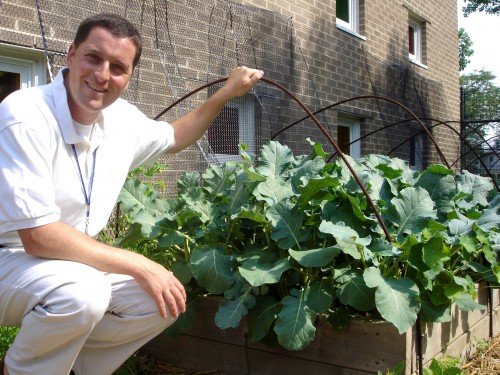
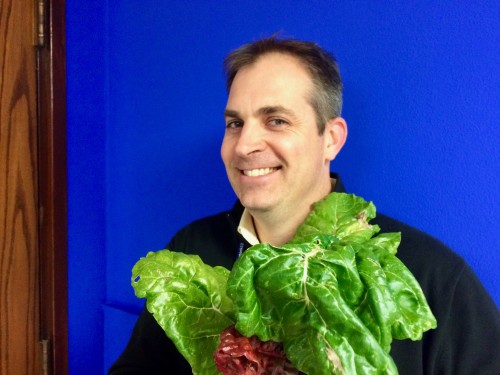 CHARDCORE: Jason Burr, principal of John Witherspoon Middle School, writes to thank Princeton School Gardens Cooperative for funding of the part-time edible gardens educator position for the school year 2017-18. The funding, provided by a partnership between the bent spoon and Whole Earth Center of Princeton, makes possible the seed-to-table efforts of Priscilla Hayes, master gardener, under way in the school’s Food Science course and also in the 501c3’s JW Cooks+Gardens program under the culinary direction of Chef Michelle Fuerst. That’s Mr. Burr with a celebratory bouquet of just-picked Swiss Chard from the JW Edible Gardens – in December!
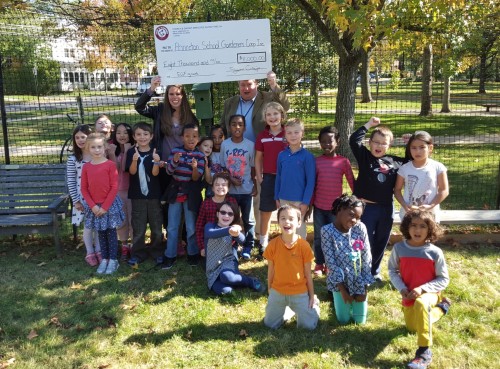
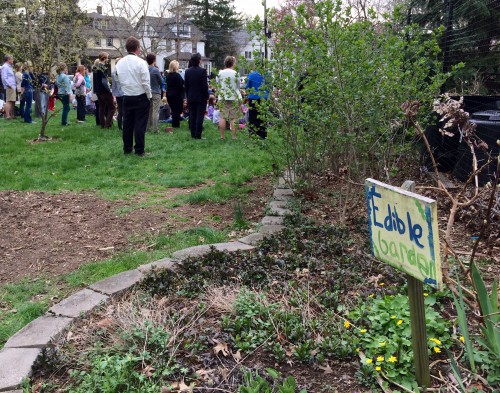
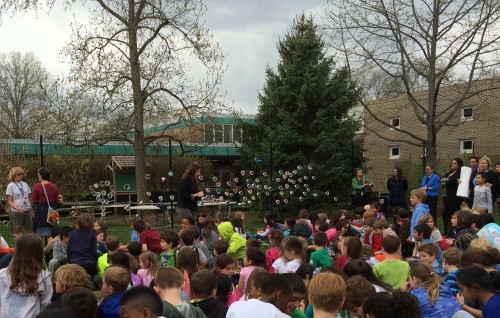
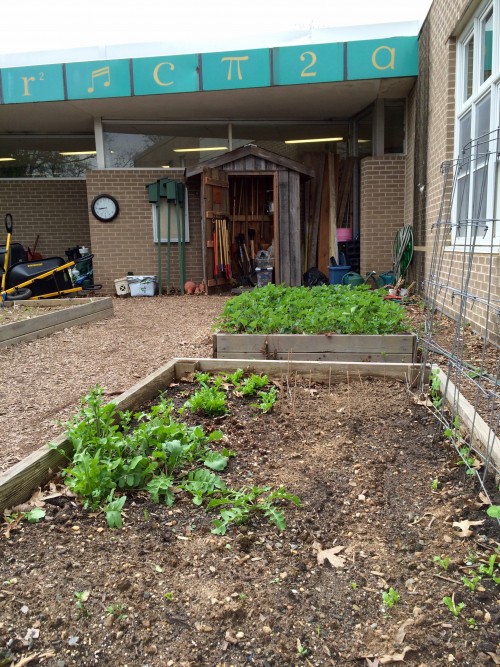
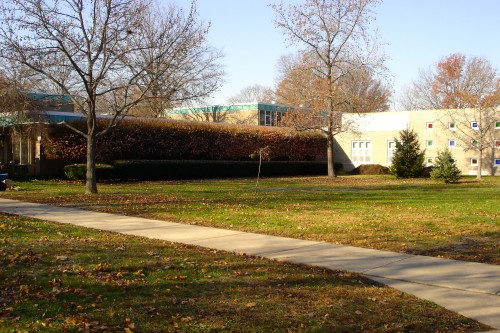
On Wednesday, April 22, 2015—Earth Day—Community Park School will celebrate 10 years of its school garden. Each student will make one recycled plastic flower from yogurt cups that have been saved by Principal Dineen Gruchacz and others, decorate it with colorful cast-off fabric and tissue paper, and hang all the flowers on the fence surrounding the school’s Edible Garden.
At 2 p.m. Princeton Mayor Liz Lempert, along with representatives of the Princeton Environmental Commission, Sustainable Princeton, and Princeton School Gardens Cooperative will join students and teachers in viewing the decorated garden, and in singing an environmental song. The song will be led by CP Science Teacher John Emmons, who has been one of the garden’s steadfast supporters during his seven years at the school, teaching classes in the garden and leading efforts in adding an innovative Prairie Garden, Light and Shadow Gardens, and a Community Forest, in keeping with Community Park’s identity as the most urban of all Princeton’s schools.
Teachers Elizabeth Czelusniak and Adam Blejwas, along with Karla Cook, whose daughters attended CP as elementary school students, remember the early days of the garden as ones that required them to involve as much of the school and larger community as possible. Czelusniak found time in her schedule to take every class out at least once. Blejwas, the school’s Spanish teacher, grew Latin vegetables such as tomatillos with students, and joined them in making salsa from the garden’s harvest.
Karla Cook, a longtime food journalist, was inspired to lead efforts for school gardens as an academic tool to connect children to the food on their plates, to each other and to the world around them. Cook and other Community Park parents joined teachers and community members, and with assistance from Dorothy Mullen, longtime Riverside School Garden Educator, constructed the first raised beds and fence for the Edible Garden.
Cook’s work at Community Park inspired her to co-found the Princeton School Gardens Cooperative (PSGC), a unique, community-scale non-profit, with Mullen, Fran McManus and Diane Landis Hackett. The PSGC, which fosters garden- and food-based education in the classroom, the cafeteria and the community, first constructed and filled edible gardens at all of the public schools in town, and still assists in fund-raising for garden educators and in garden maintenance. Now, edible garden efforts are amplified and illustrated four times a year by the PSGC-sponsored Garden State on Your Plate program, which brings chefs, farmers and artisan producers into the cafeteria at lunchtime to serve up small portions of simple recipes made with fresh ingredients. The program is generously funded by the Office of Community and Regional Affairs at Princeton University.
In addition to funding from PSGC, the Community Park School Garden is supported by the school district and the school’s PTO. The funding goes for supplies and to pay an award-winning garden educator Priscilla Hayes, who has been leading gardening and sustainability efforts since the 1990s, when she originated programs in the Robbinsville Township schools as part of her Recycling and Clean Communities work. Hayes partners with Emmons and other teachers in programs linked to curriculum already in place, including as a project to grow indoor clean air and a student redesign of the Lenape-oriented Three Sisters bed as a Five Sisters bed.
In recent years at Community Park, Stephanie Chorney, a parent and pediatrician, has helped coordinate efforts in the school gardens and co-chairs the PTO’s Go Green Committee, with Sandy Moskovitz. Community Park also has a Food and Flavor Health Residency with McManus, which is coordinated by another parent, Lee Yonish. The Food and Flavor program highlights tastings of some fruits and vegetables grown in the edible gardens, where students develop their palates and critical thinking skills in their approach to food. An apple tasting that McManus might lead, for example, would have students observe and chart differences in color, texture, flavor, and physical shape, as well as what varieties disintegrate or hold up to cooking.
— Priscilla Ellen Hayes, School Garden Educator
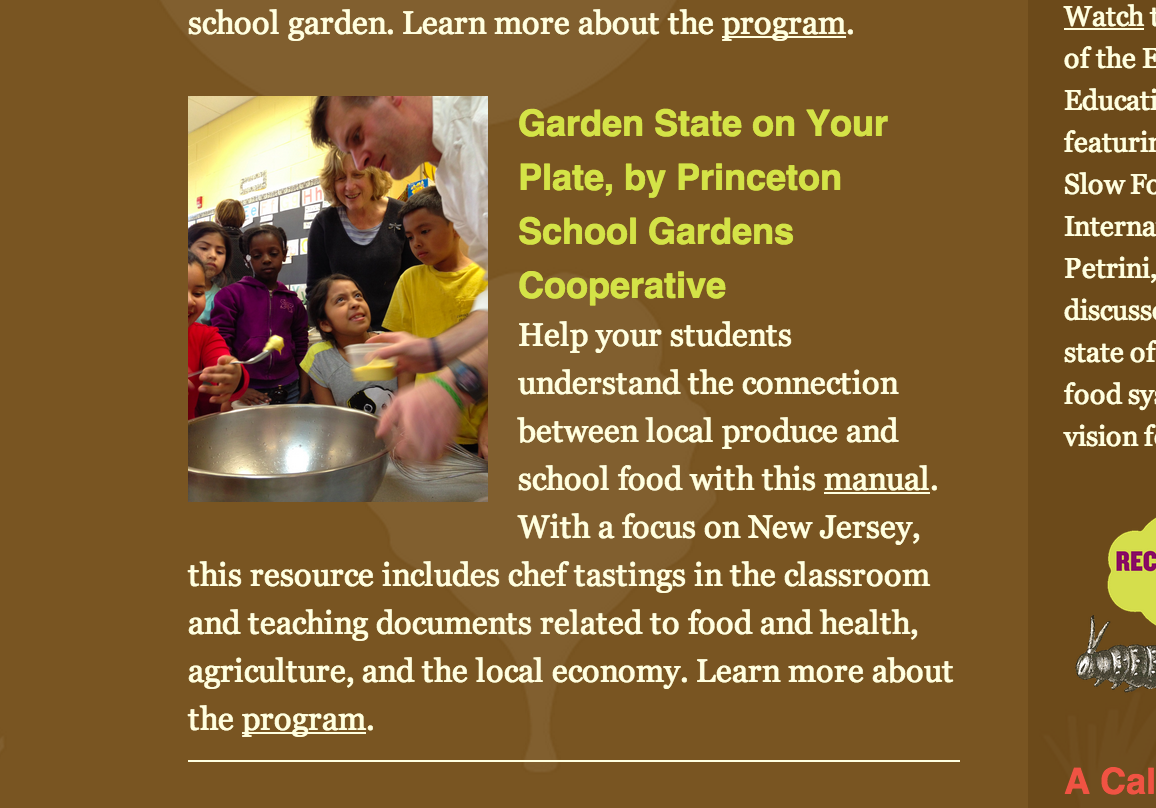 The Princeton School Gardens Cooperative was invited to submit a link to its how-to manual on establishing and running school-wide tastings. It made the grade – the Garden State on Your Plate manual was recently featured on the national newsletter.
At a recent teacher-garden workshop hosted by the Princeton Public Library, Sharon Goldman, principal at Community Park Elementary School, explained her evolution to enthusiastic booster of the gardens and food-based learning. The workshop, conducted by Dorothy Mullen and Diane Landis of the Princeton School Gardens Cooperative, drew 80 participants from the mid-Atlantic region.
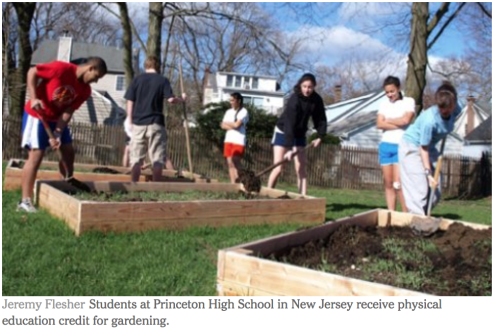 From the piece: Starting this week at Princeton Public High School, students can take gym class in the garden.
“I think it’s strangely enjoyable,” said Tim Vasseur, a Princeton sophomore, shovel in hand. “It’s definitely not easy to do or anything like that.”
Advocates for greener schools believe this is the first time public school students will receive physical education credit for garden work. The idea was conceived by Matt Wilkinson, a physical education teacher and a former wrestling coach who also has a background in horticulture.
“We’re giving students another option to mainstream physical education,” Mr. Wilkinson said. “How long is somebody going to play basketball or soccer? Gardening they can do their whole lives.”
Last fall, members of the community raised $1,500 and constructed 16 raised garden beds on school property. Now that it’s spring, students will get to work planting seeds, weeding, and turning compost.
“It gives people who aren’t that athletic — and I feel like I’m not — it gives them an opportunity to do something else,” said Kruthi Isola, a sophomore. “You learn how to do more than just play a game.”
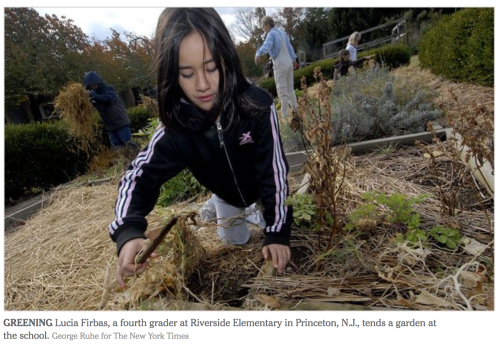
From the piece: Welcome to the Princeton School Gardens program. Here, children regularly work in one of the district’s 15 gardens during school hours, preparing garden beds, planting herbs and vegetables and harvesting them when they are ripe. The students eat raspberries from their own raspberry plants, sample cherry tomatoes off the vine and take bok choy, kale and cabbage home to cook and eat.
“We made sure that everything in our herb garden was edible, and when the children go out there, you can see them eating fistfuls of flowers and plants — they’re just munching them right on the spot,” said Dorothy Mullen, a parent who was the driving force behind the school gardens project in Princeton, which started seven years ago.