
Littlebrook Elementary School celebrated Food Day, Oct. 21, with a garden feast made with produce from the children’s edible gardens on campus. The menu included rosemary scones, beets and beet greens and home-grown popcorn. Festivities drew the attention of a reporter from the Princeton Packet, and netted a front-page story. story.
Archives
Community dinner hosted by Princeton University
We scooped Bent Spoon’s Princeton School Gardens chocolate-rosemary ice cream as dessert for the Corner House/Princeton University’s Community Dinner under the stars that coincided with the second annual Food Day nationwide. The event drew about 300 people, most of whom were given white T-shirts to help carry out a white theme.
Michelle Obama served tomatoes, Bent Spoon cupcakes made with herbs from school gardens
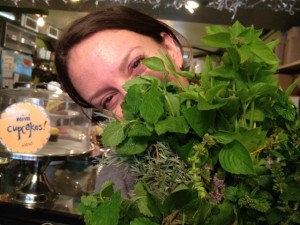
First Lady Michelle Obama, champion of good food, edible gardens and invigorating exercise regimens, was served produce from Littlebrook and Riverside school gardens at a lunch she attended last Sunday to raise funds for the re-election campaign of President Barack Obama.
Max Hansen, whose eponymously named catering company of Pipersville, PA, provided the meal, said that guests were served cherry tomatoes and basil from Riverside Elementary School gardens along with Comeback Farm (Hunterdon County, NJ) heirloom tomatoes in a salad of Blue Moon Acres (Pennington, NJ and Buckingham, PA) baby greens. For dessert, Mr. Hansen served Gab Carbone’s Bent Spoon cupcakes slathered with a choice of three buttercream frostings infused with herbs from the Littlebrook Elementary school garden: lavender, lemon balm and chocolate mint. He said that he was able to mention to the First Lady that the herbs were picked from Princeton School Gardens.
The lunch was served in the back gardens of Andy and Carol Golden’s home, overlooking a valley behind North Snowden Lane, near Herrontown Road.
Food and agriculture co-star at film festival
 For inspiration, a call to arms and gatherings of well-mannered rabblerousers, look no further than the Princeton Environmental Film Festival, which begins January 26 and runs for three consecutive four-day weekends.
Hosted by the Princeton Public Library and now in its sixth year, the event is coordinated by librarian Susan Conlon and other community volunteers.
There's a meal — Sustainable Princeton's Great Ideas Breakfast, Friday, Feb. 10, 8:30 a.m. — and there are several films that are of interest to the good food crowd. If you're unable to attend a screening, no worries, says Ms. Conlon – most of these DVDs are available at the library.
"Shellshocked: Saying Oysters to Save Ourselves," Saturday, Jan. 28, 12:30 p.m. Follows efforts to prevent extinction of wild oyster reefs, which have been declared 'the most severely impacted marine habitat on Earth' and no longer play a role in ocean ecosystems.
"Rescuing the Raritan," Saturday, Jan. 28, 2 p.m. Tells the story of the Raritan River, a source of water for more than a million people in New Jersey, its contamination and how government agencies, corporations, environmentalists, developers, scientists and lawyers have clashed over cleanup. Followed by a Q&A with filmmaker Eric Schultz.
"Food Stamped," Sunday, Jan. 29, 1 p.m. Follows a couple as they attempt to eat a healthy, well-balanced diet on a food stamp budget. Along the way, they consult with members of Congress, food justice organizations, nutrition experts and people living on food stamps for a deep look at America’s food system. Panel discussion follows, featuring Julia Hicks de Peyster, who attempted to feed her family of five on the allotted food stamp budget for forty days; Crisis Ministry of Princeton and Trenton's Hunger Prevention Director Mark Smith; and moderator Liz Cohen of Yes We CAN! Food Drives, which supports the Crisis Ministry.
"Sola, Louisiana Water Stories," Thursday, Feb. 2, 7 p.m. Water stories from Southern Louisiana (SoLa) which supports the biggest economies in Louisiana – a $63 billion-a-year oil and gas industry and a $200 million-a-year fishing business, in addition to tourism and recreational sports — and is home to some insidious polluters along "Cancer Alley," a 100-mile-long stretch of the Mississippi known as “Cancer Alley," the world’s largest Dead Zone and erosion that is costing the coastline 25 square miles of wetlands a year. Q&A with director Jon Bowmaster will follow.
"Call of Life," Friday, Feb. 3, 4 p.m. Investigates growing threat posed by rapid and massive loss of biodiversity on the planet. Caused by human activity, this contemporary mass extinction, is disrupting and destroying the complex, interconnected biological systems that support life on earth. Its primary drivers are habitat destruction, global warming, pollution, and invasive species, all compounded by the expanding human population and our consumption patterns. Q&A with executive producer David Ulansey to follow.
"The Clean Bin Project," Saturday, Feb. 4, 4 p.m. Jen and Grant compete to see who can produce the least landfill garbage in an year. Their light-hearted contest is set against a darker examination of waste in the U.S. and the large-scale environmental impacts of a throw-away society.
"Mother: Caring for 7 Billion," Sunday, Feb. 5, 4 p.m. Examines population growth, which fuels our most pressing environmental, humanitarian and social crises. Grounded in theories of social scientist Riane Eisler, the film strives to highlight a different path for humanity – one of nurturing rather than conquering, or domination.
"Urban Roots," Friday, Feb. 10, 10:30 a.m. Explores the urban farming phenomenon in Detroit, addressing the epidemic of collapsed industrial towns and the need to forge a sustainable and prosperous future.
"Truck Farm," Saturday, Feb. 11, 4 p.m. Using green-roof technology and heirloom seeds, Ian Cheney plants a vegetable garden on the only land he has: his Granddad’s old pick-up truck. Once the mobile garden begins to sprout, viewers are trucked across New York to see the city’s funkiest urban farms, and to find out if America’s largest city can learn to feed itself. Q&A with director Ian Cheney follows.
Short Films and Talk on Ocean Habitat Conservation, Sunday, Feb. 12, 3 p.m. Stan Waterman, a legendary underwater photographer, filmmaker and diver, and Carrie Manfrino, director of research and conservation for the Central Caribbean Marine Institute, return to the Princeton Environmental Film Festival to discuss their work and share some of their films and stories.
Emissions database
Explore greenhouse gas emissions – minus those from agriculture, transportation or forestry, which are not required to report them in detail, at http://ghgdata.epa.gov/ghgp/main.do. The data, which were drawn from 6,157 sources and are current through 2010, covered nearly 80 percent of the country’s greenhouse gases from large industrial sources.
Money and politics database
To understand money’s influence on politics, use the searchable database of Maplight at http://maplight.org/. Search by bills, legislators, interest groups, contributions and companies. It’s interesting to note, for example, that the National Beer Wholesalers Association has contributed $7,108,000 to members of the House and Senate and has taken a position on nine bills before Congress, making it fourth behind the National Association of Realtors, AT&T and Honeywell.
Growing power at PHS
Edible Gardens at Princeton High School were created in 2011, with a community garden-raising. More than 75 community members turned out to build and fill a collection of 13 raised beds on a sunny November afternoon. The Edible Garden beds were host to Matt Wilkinson, who taught a PE class with a garden theme, and also by Paula Jakelow, horticulture teacher.
Anna Rose Gable, ESL teacher and PSGC Edible Gardens coordinator, is overseeing the return of the Edible Gardens.
July 2011
The outdoor classroom – and edible gardens – at Community Park took a giant leap forward in June with the expansion of the fenced area, courtesy of Judy Wilson, Princeton Regional Schools superintendent.
Now, the picnic tables are beneath the shade of a tree and there is grassy area for doing cartwheels or stretching a beach towel out for looking up at the sky. And the gardens can expand as desired.
John Emmons, science teacher who also once worked in a greenhouse, is taking the lead in both the edible and ornamental garden beds. Edible: two varieties of Swiss chard, sugar snap peas, English peas, lettuces, broccoli raab, red cabbage and kohlrabi. “Whatever cool-weather crops I could find, I got.” said Mr. Emmons. Ornamental: sweet peas and California poppies.
Janet Thomas is working with Mr. Emmons to create a Japanese-inspired shade garden in a Zen style. As part of this work, the two will re-locate the spring bulbs. Ms.Thomas will also use the Zen garden to further her students’ understanding of Chiura Obata, the Japanese-American artists who painted Yosemite Valley.
Curricular links
If edible gardens can continue to expand, Mr. Emmons hopes to plant representative Japanese, Asian, Hispanic, Mediterranean, Native American and Italian gardens, among others. This expands on the existing work of Adam Blejwas, who has grown tomatillos and other ingredients for his classroom salsa-making lesson that he has taught the 4th graders. Ms. Thomas will use the new Zen garden to tie in with her classroom study of feature maps. Japanese gardens re-create geographical features, she said, using mosses and ferns – with gravel as the sea, and rocks as mountains.
Obstacles to participation
“We’re at the beginning,” said Mr. Emmons of the outdoor classrooms. “First, you build it and they will come.” His goal, he said, is to help teachers and administrators see that it’s a wonderful space, and that the students will enjoy outdoor classes even more than sitting inside. “I want to encourage teachers to develop their own uses for the gardens, and encourage them to get out there more. I want them to say, “Wow, this is nice!”
CP edible gardens area grows
The outdoor classroom – and edible gardens – at Community Park Elementary School took a giant leap forward recently, with the expansion of the fenced area, courtesy of Judy Wilson, Princeton Regional Schools superintendent.
Now, the picnic tables are beneath the shade of a tree and there is grassy area for doing cartwheels or stretching a beach towel out for looking up at the sky. And the gardens can expand as desired.
NJ Farm to School Network
This group works to improve school food, promote locally grown produce and educate through school gardens. Directed by Beth Feehan, the 501c3 gathers leaders in the field: Dorothy Mullen, master gardener and co-founder of the Princeton School Gardens Cooperative; Gary Giberson, of Sustainable Fare and executive chef at Lawrenceville School; Lisanne Finston, executive director of Elijah's Promise in New Brunswick; Sal Valenza, food service director of West New York, NJ, school district, and Meredith Taylor, director of urban agriculture and environmental education, at Isles, in Trenton. For more information, visit the website, http://www.njfarmtoschool.org.